Commerical Photography

The upside of advertising photography

So what’s cooking in the kitchen?

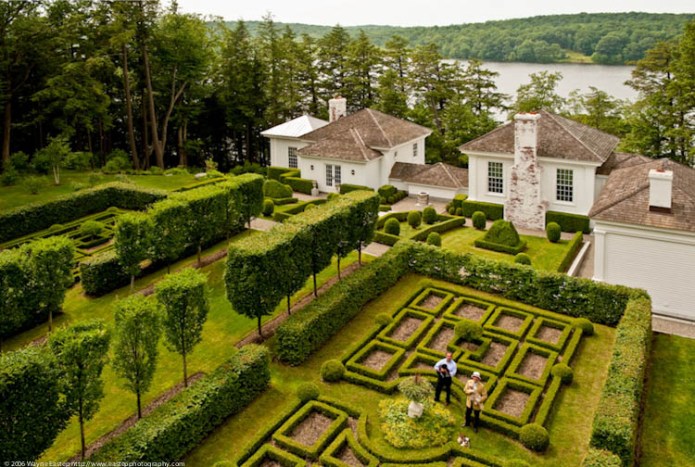
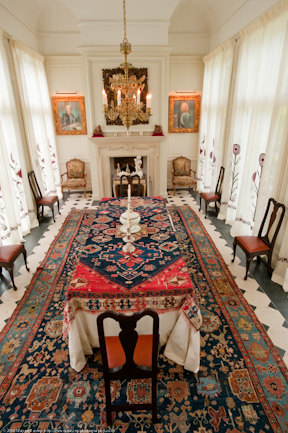
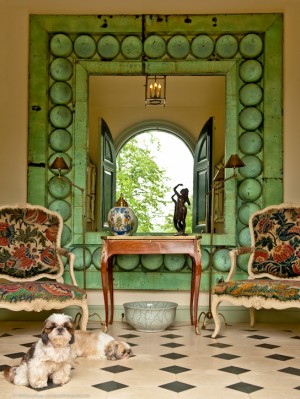
This ad features Paris-born designer Robert Couturier and his partner Jeffrey Morgan at their elegant Connecticut home filled with centuries of antique treasures.  It is the most recent of 16 ads I’ve shot for the GE-Monogram brand campaign, “So what’s cooking in the kitchen?”  The theme of the campaign features people whose personal and professional lives exemplify style.  Working on projects like this is one of the reasons I do lifestyle advertising photography.  In addition to meeting and working with superbly talented people like Robert and Jeffrey, I get to see and photograph beautiful and fascinating places I normally would not have access to.  Another great benefit is the fabulous food.

Some of the other people I’ve photographed for this campaign include:  Mark Miller, Martha Stewart, Alton Brown, Bo & Heidi Barrett, Richard Wurman & Gloria Nagy, Annette Theisen, Thomas & Justyna Roszak, Phil & Jamie Kellogg, David Cornell & Mea Argentieri, David & Macarena Dearie, John Dransfield & Geoffrey Ross, B. Smith & Dan Gasby, Dr. Walt & Suzie Fairfax, Donald Trump, and Jay Leno.

If you are privileged as I am to work on exceptional projects like this, you’ll acknowledge that the ad only succeeds if the client supports the concept completely.  Paul Klein from GE-Monogram is such a client. The creatives at the agency must have a clear idea grounded in the uniqueness of the product—it’s all about the idea.  Bill and Sheila    McCaffery of The Creative Farm exemplify an approach to advertising that focuses on a clear idea.  I turn the idea into an image, but it’s my team who make it happen.  William DeVincenzo, “D,”  is my right hand man who makes sure every detail is taken care of.  On jobs like these it’s all about the details.

Images of the Couturier Morgan home in Connecticut.  If you would like to hear Robert talk about his new kitchen visit:                                                       http://www.monogram.com/get_inspired/see_whats_cooking/couturier.htm.

Courturier CT home

To see other images I’ve shot in this campaign visit:  http://eastep.photoshelter.com/gallery/Lifestyle/G0000OyRO5rOs6OA/

Standard
Recent Personal Images

America’s No. 1 Beach

The Best Beach in America

Best Beach in USA

America's Best Beach

Siesta Beach, Sarasota, Florida

This is what happens when people discover you have the “Best Beach in the USA.”  They come cover it up and make phone calls.  Hang on. Who says it’s the best, and who made them an authority?  Well Dr. Beach of course!  Yes, there is a Dr. Beach, Stephen P. Leatherman, Director of Florida International University’s Laboratory for Coastal Research.

This is what the doctor says…”Siesta Beach in Sarasota boasts that it has the finest and whitest sand in the world, and I cannot argue with this claim; the powdery sand is nearly pure quartz crystal.  The beautiful blue-colored water is clean and clear, making it so inviting to bathers and swimmers.  The beach is hundreds of yards wide, attracting volleyball players and beachcombers as well as those who just want to find their place in the sun.  Waves at Siesta Key Beach are normally measured in inches and the beach gradually slopes into the Gulf waters, making it very safe area for children.” Consumer Traveler, May 31, 2011

I actually prefer Lido Beach on Lido Key in Sarasota, FL – mainly because it’s closer to my home.

Standard
Recent Personal Images

A brush with the Paranormal

Photographing lightning is straightforward: attach the camera to a tripod, set the lens aperture to f 5.6, the shutter on bulb and focus on infinity.  During a period when there is lightning activity press the shutter release and leave the shutter open until one or two bolts of lightning appear.  This is normally done at night.

When the storm is during daylight this method does not work because leaving the shutter open for 30 seconds or more while you wait for the lightning bolt results in a washed out image.

One afternoon a powerful storm was developing over the Gulf of Mexico.  I went out to the beach and set up my tripod and camera.  Eager to photograph lightning during these afternoon summer storms I concentrated on a particular cloud formation just offshore Lido Beach in Sarasota.  I watched with what might be called hyper-focus, attempting to connect with the energy in the developing storm and anticipate when the lightning would develop.  Another way of saying it is I was guessing.  Because it was daylight I set the aperture to f 8, the shutter to ¼ second, the focus on infinity and waited.  When I felt the energy was at the instant of release I pressed the shutter.  This is the image I made.

Summer storm offshore in the Gulf of Mexico

I remained at the beach trying to connect to the energy in the storm and got lucky again.

thunderstorm Gulf of Mexico

Thunderstorm Gulf of Mexico

Standard
Recent Personal Images

Light & Dark in the Florida Everglades

Florida Everglades storm at sunset

Confrontation of Light and Dark over the Florida Everglades

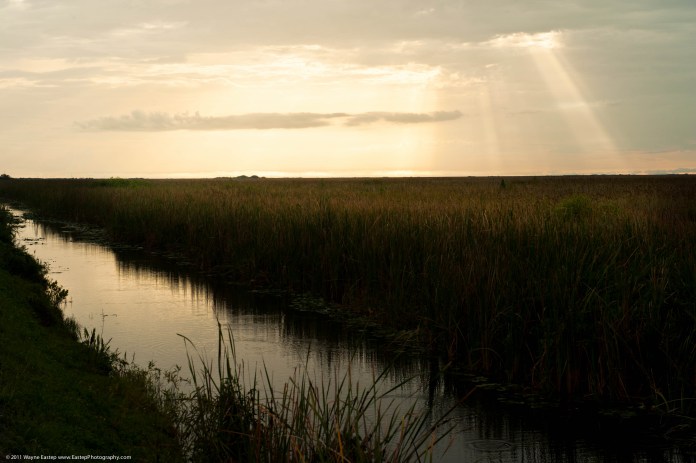
After posting the image of a recent storm over the Everglades I remembered this image I made a few years ago.  The storms in Florida are often matched by  brilliant specular light which is often full of color.  It’s interesting to me how these images taken years apart suggest how much things remain the same, particularly in nature.  That’s a reassuring thought.

Standard
Recent Personal Images

Rain over the world’s largest marsh

Sawgrass under a summer storm in the Florida Everglades

A welcome summer storm over the Florida Everglades

Finally rain.  South Florida has suffered through a dangerously dry period so the recent rains are welcome.  This storm was over the Everglades on Sunday June 26, 2011.  One of the features of the Florida Everglades is the way light falls on the Sawgrass creating a magnificent pattern on the grasses.  Sawgrass, Cladium jamaicense, is technically not a grass but a sedge.  Sawgrass is one of the oldest plant species and perfectly suited to the harsh conditions of a swamp.  It represents one of those detail features of nature which we must protect.  The horizontal profile of the Everglades creates a visual condition which has a calming and peaceful effect.  Take a moment and enjoy.  Wayne

Standard
People who have influenced me

Ernst Haas’s influence on my way of seeing

ERNST HAAS

Abalone Shell, ©1970 Ernst Haas

1971:  The Creation, a book of photographs by Ernst Haas, transfixes me. The images are part meditation and part creative expression. After studying the photographs for days, I became aware of a new way of seeing.  These images go beyond the descriptive to explore a subjects essence.  THE CREATION cover is less about the abalone shell and more a metaphor for the universe. The shapes and colors suggest the swirl of planets and stars.  Having an image trigger associations like this has never happened for me before.  Ernst’s images plant the seed in my imagination of merging poetry and pictures, and eventually draw me to photography as a profession.

Five years passed before I took action to become a photographer.  The path I chose was an apprenticeship with Burt Glinn at Magnum.  During this time I had the honor of meeting Ernst Haas and over the next two years came to discover his grace, style and humanness.  When I started work on my first book, Bedouin, Ernst generously shared the following advice with me and that guidance proved to be sound and  I’ve continued to follow.

Read poems by children from the culture you’re studying, look at their drawings. Children show us a world drawn from their intuition.  Do not make an outline because it will become a structure that will define your process.  Simply start working and making photographs.  People around you will say, “Oh, you’re interested in that, well let me show you this.”  They will develop the story and it will have a natural progression.  Make sure you wear comfortable shoes.  If your feet hurt it will distract you from the experience.
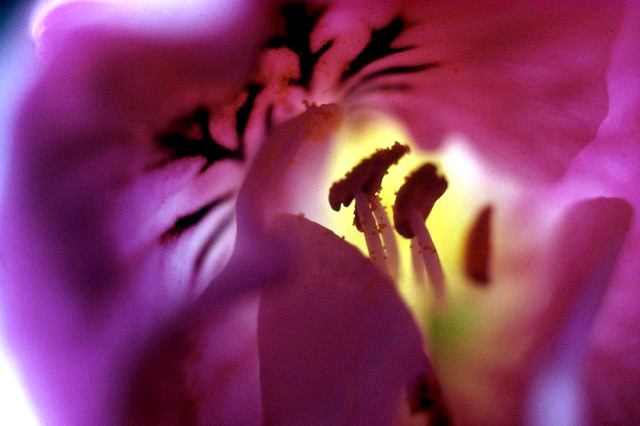
Geraniums, Long Island  ©1961 Ernst Haas

Todd Weinstein, Ernst’s longtime assistant, told me a story about preparing contacts from Ernst’s photographs of World War II refugees.  Todd was making contact sheets from the two and quarter negatives and noticed he was placing one frame at a time on the contact frame and not a strip with three or four frames as is normal.  He asked Ernst why there was only one frame and where the rest of the images were.  Ernst answered,  “That’s all there is.  We couldn’t take a lot with us (when moving from the war front to safety) so I selected the one I thought best, cut it out and left the rest behind.”

Ernst had a creative courage that enabled him to trust his instincts.  He would embark on a project without a client funding the work.  There would be a basic idea, but no production plan or outline organizing the subjects.  He trusted the idea that the subject would show itself and share with him what needed understood.  Rather than imposing a preconceived idea he was open to discovery.
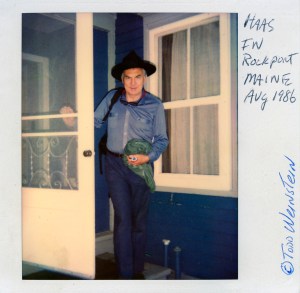
Ernst Haas


© Todd Weinstein 1986     http://www.toddweinstein.com

Jay Maisel shared with me Ernst’s admonition, “One should move around freely and have fun, and if it isn’t fun then don’t bother.”

The style of Ernst’s work reveals a sensitive and intimate humanity.  His images were not simply documents of a person, place or object.  He photographed in a way that revealed humanity in a gesture or glance.  The essence of beauty is expressed in his photographs of a flower. When photographing a storm on the ocean he is putting us in touch with the power of nature.  His study of an abalone shell is not an image of natural history; it is a meditation on the mystery of creation.
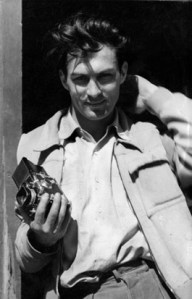
Ernst Haas gave us an example of what we can create if we trust that fragile and powerful place within our mind called intuition.  We see best when we are open and responsive to the wonder of the world, as we were as children.  His example calls us to stop doing so much and start being.  Simply be still and see.  When we are in that frame of mind the subject will open and show something of itself to us.  What we learn will inform our images and what we create will be worth sharing.

Early portrait, Munich      © Ernst Haas Estate, http://www.ernst-haas.com/
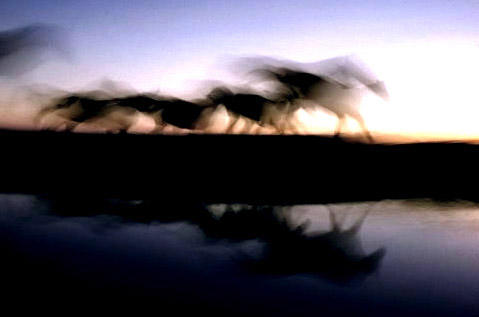
Motion study of horses by Ernst HaasWild Horses, Nevada,   © 1957 Ernst Haas

To see more images by Ernst and learn about his life and contribution to photography visit the ERNST HAAS ESTATE  http://www.ernst-haas.com/

Standard
Uncategorized

Business Advice

“Dress British, Think Yiddish” was  advice given by the head of Paramount Pictures Adolph Zukor to his young producer in training A.C. Lyles.

Standard
People who have influenced me

Nothing new under the sun?

Manuscript illustration

15th c. manuscript illustration, Kazakhstan

Solomon declared long ago, “there is nothing new under the sun.”  This statement is only partially accurate.  Granted the human condition today is similar to the way it was in Solomon’s time.   However, our study of the laws of nature teaches us that each day under the sun things are new and renewed.  What is new is how we each experience life.  Seeing is one of the glorious ways we observe life.

I see in a unique way.  There are many who’ve informed  and influenced the way I see and think about all the wonderful new things and people under the sun.  Continue reading

Standard